

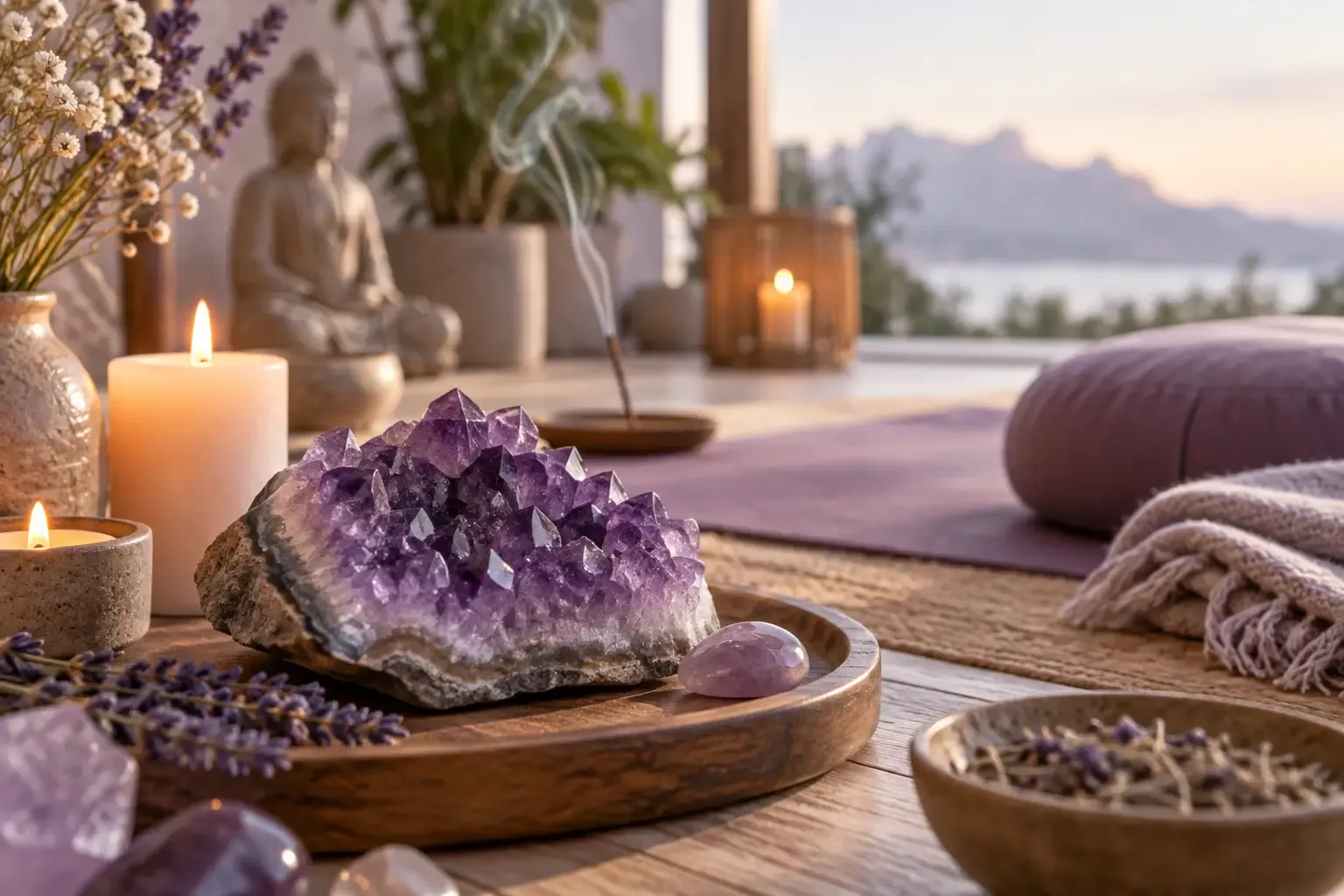
Amethyst has fascinated different cultures for centuries not only for its violet color, but also for the symbolic and spiritual meanings attributed to it.
Today it is common to find references to the energy properties of amethyst, especially within practices linked to meditation, crystal healing, spiritual well-being and various esoteric currents.
According to these traditions, amethyst would be associated with calm, mental clarity, energetic protection and emotional balance.
It is important to make a distinction from the outset: these benefits form part of spiritual beliefs and traditional practices. There is no solid scientific evidence that amethyst by itself produces specific therapeutic, medical or psychological effects.
That does not prevent, however, many people from using it as a symbolic object, a decorative element or a support within relaxation and meditation routines.
What does amethyst represent spiritually?
Within different traditions, amethyst is usually related to concepts such as:
- calm;
- serenity;
- introspection;
- mental clarity;
- balance;
- protection;
- spirituality;
- meditation.
Its violet color has also historically contributed to its association with the spiritual, the ceremonial and the contemplative.
In many contemporary practices, amethyst is considered a stone linked to the search for tranquility and inner connection.
What energy properties are attributed to amethyst?
The attributed properties can vary considerably depending on the tradition or spiritual current.
There is no single universal interpretation.
However, there are several associations that appear frequently.
1. Calm and relaxation
One of the most mentioned benefits is its supposed capacity to favor a sensation of calm.
For this reason, some people place amethysts in:
- bedrooms;
- meditation spaces;
- rest rooms;
- places intended for yoga;
- reading corners.
From a practical perspective, an object that a person consciously associates with tranquility can form part of a relaxation ritual.
That does not mean that the mineral scientifically emits an energy capable of reducing stress, but it can function as a symbolic element within a personal routine.
2. Mental clarity
Amethyst is also attributed with the capacity to help organize thoughts and favor concentration.
Some people use it during activities that require attention, reflection or decision-making.
It can be found, for example, on desks or workspaces.
Within these beliefs, the violet of amethyst is associated with a calmer, less saturated mind.
Again, this forms part of spiritual interpretations and not of a demonstrated neurological effect.
3. Emotional balance
Another of the properties attributed to amethyst is the capacity to promote emotional balance.
People who work with crystals may use it during moments of introspection or when seeking to connect with their emotions in a more conscious way.
In this context, the stone functions mainly as a symbol.
Holding an amethyst, observing its crystals or using it during a breathing practice can become a signal to pause for a few minutes and pay attention to one’s emotional state.
4. Energetic protection
Within crystal healing and other spiritual practices, one of the best-known properties of amethyst is the supposed protection against negative energies.
Some people believe it can help create more balanced environments or act as a kind of energetic barrier.
For this reason, amethyst geodes or druses are placed near:
- entrances;
- living rooms;
- bedrooms;
- workspaces;
- places used for spiritual practices.
This idea belongs to the realm of energetic beliefs and has not been scientifically demonstrated.
5. Meditation and introspection
Amethyst is probably one of the most used stones in meditation practices.
Its appearance, color and luster can help create a visual environment associated with calm.
Some people hold a small stone during meditation.
Others place a geode in front of them as a visual concentration point.
It can also be used simply as a decorative element within the space intended for the practice.
In this case, the benefit may be more related to ritual, mindfulness and personal association than to any special physical property of the mineral.
6. Intuition and spirituality
In some esoteric currents, amethyst is related to the development of intuition and spiritual perception.
It is also usually associated with practices oriented toward self-knowledge.
These interpretations come mainly from modern traditions linked to crystals, chakras and spirituality.
There is no scientific basis for asserting that the stone objectively increases intuition.
However, some people find symbolic value in using it as a reminder to pay more attention to their thoughts or sensations.
Amethyst and the crown chakra
Within traditions that work with chakras, amethyst is usually associated mainly with the crown chakra, symbolically located at the top of the head.
This chakra is related, within these beliefs, to concepts such as:
- consciousness;
- spirituality;
- inner connection;
- wisdom;
- understanding.
It can also be found associated with the so-called third eye.
These ideas belong to traditional and modern spiritual systems, not to anatomical structures recognized by medicine.
Does amethyst help you sleep?
It is common to find claims that amethyst can help you sleep better.
Some people place a small piece or geode on the bedside table or near the bed.
However, there is no solid scientific evidence that amethyst has a direct effect on sleep.
What can happen is that it forms part of a relaxing routine.
If a person associates a certain stone with calm, turning off devices, reducing lighting and doing a small breathing practice before sleeping, the complete ritual can help create better conditions for rest.
In that case, the effect should not necessarily be attributed to the stone.
Can amethyst reduce stress?
The claim that amethyst directly reduces stress is also not scientifically demonstrated.
However, it can form part of activities that do favor relaxation.
For example:
- meditation;
- conscious breathing;
- yoga;
- contemplation;
- breaks during the workday;
- creating a quiet space.
A stone can act as an object of focus or a reminder within these practices.
How do some people use amethyst?
There is no right or wrong way within spiritual practices.
Some of the most common uses are the following.
Carrying a small stone
It can be carried in a pocket, bag or as a piece of jewelry.
Those who follow energetic practices consider that this allows them to maintain a symbolic connection with the properties they attribute to the mineral.
Placing a geode at home
Amethyst geodes are especially popular in decoration.
Beyond their aesthetic value, some people place them in certain spaces because they believe they help generate a calmer atmosphere.
Using it during meditation
A person can hold a stone, place it in front of them or simply keep it nearby during the practice.
Incorporating it into the workspace
It can be used as a decorative object or as a visual reminder to take small breaks.
Does a large geode have more energy than a small one?
Within some energetic practices there is a belief that a larger geode would have a broader influence on the space.
However, this cannot be measured or scientifically demonstrated.
From a mineralogical point of view, a large geode simply contains a greater amount of material and a more extensive crystalline surface.
From a decorative point of view, it will naturally have a greater visual impact.
But there is no evidence that size produces greater “energetic power”.
Do you need to energetically cleanse an amethyst?
Many traditions related to crystals speak of “energetic cleansing” processes.
Among the most used symbolic methods are:
- moonlight;
- smoke from herbs or incense;
- sound;
- visualization;
- placing the stone next to other minerals.
These practices do not scientifically modify a supposed energy stored in the crystal, but they can have ritual or symbolic importance for those who perform them.
It is also worth distinguishing energetic cleansing from physical cleaning.
A real mineral piece can accumulate dust and need proper care to preserve its appearance.
Can amethyst be left in the sun?
It is not advisable to expose certain amethysts to intense sunlight for prolonged periods.
Prolonged exposure can affect the color of some pieces.
For this reason, even within spiritual practices, it is usually preferable to avoid leaving amethysts under direct sun for many hours.
This recommendation is not energetic, but related to the conservation of the mineral.
Does amethyst have medicinal properties?
There is not enough scientific evidence to consider amethyst a medical treatment.
It should not be used as a substitute for:
- medical care;
- treatments indicated by professionals;
- medications;
- psychological therapy;
- professional diagnosis.
Stones can be used as decorative or symbolic elements, or within personal wellness practices, but they should not replace health treatments.
Why do so many people feel a connection with crystals?
The relationship between a person and an object can have a strong psychological, emotional and symbolic component.
Human beings have spent thousands of years giving meaning to certain materials, colors and objects.
A stone can represent:
- a memory;
- an intention;
- a personal stage;
- a spiritual practice;
- a gift;
- a bond with nature.
That meaning can be real and important to the person without needing to prove that the crystal emits a special physical energy.
Amethyst as an object of contemplation
There is also an aspect that needs no esoteric explanation.
An amethyst geode can be extraordinarily beautiful.
Observing the depth of its crystals, its variations of violet and the natural forms that developed over millions of years can generate a sensation of fascination or calm.
In this sense, an amethyst can work in a way similar to a plant, a work of art or a landscape.
It can help us pause for a few moments and observe something attentively.
Amethysts of Artigas and connection with nature
In Uruguay, amethysts from the department of Artigas allow another dimension to be added to that symbolic relationship.
Each piece comes from a geological process that began millions of years ago.
Before reaching a home, a jewel or a meditation space, it remained hidden within ancient basaltic rock formations.
For some people, knowing that origin strengthens the sensation of connection with nature.
Beyond energetic beliefs, the geological story of an amethyst is completely real and extraordinary.
Spiritual belief and scientific evidence can coexist with clarity
It is not necessary to present a spiritual practice as a scientific fact to recognize the value it can have for some people.
A person can use amethysts during meditation because they find them beautiful, symbolic or meaningful.
Another can keep them solely as collection minerals.
Another can buy them for their decorative value.
All those uses are valid.
What matters is clearly differentiating between what belongs to the realm of beliefs and what can be scientifically demonstrated.
Frequently asked questions about the energy properties of amethyst
What energy is amethyst said to have?
Different traditions relate it to calm, mental clarity, spirituality, protection and emotional balance.
Does amethyst protect against negative energies?
That is a common belief within some spiritual practices, but there is no scientific evidence demonstrating this effect.
Where should amethyst be placed at home?
Those who follow energetic practices usually place it in bedrooms, living rooms, meditation spaces or workplaces. It can also simply be placed wherever it works best as a decorative piece.
Is amethyst good for sleep?
There is no scientific evidence of a direct effect on sleep. It can form part of a relaxing routine, but it should not be considered a treatment for sleep problems.
Does amethyst help with anxiety?
There is no evidence that the stone treats anxiety. It can be used as an object during relaxation practices, but persistent difficulties should be addressed with appropriate professionals.
What is the spiritual meaning of amethyst?
It is usually associated with serenity, introspection, clarity, spirituality and inner connection.
Do you have to believe in energy properties to enjoy an amethyst?
No. It can be appreciated for its beauty, geological origin, decorative value or mineralogical interest regardless of any spiritual belief.
One stone, many meanings
Amethyst can be observed from completely different perspectives.
For geology, it is a violet variety of quartz.
For a collector, it can be an exceptional mineral specimen.
For a decorator, a visually striking piece.
And for those who follow certain spiritual traditions, it can represent calm, protection and inner connection.
The energy properties of amethyst form part of that universe of cultural and personal meanings.
They are not scientifically demonstrated as therapeutic properties of the mineral, but they remain an important part of the relationship many people maintain with these stones.
And when we speak of a natural amethyst from Artigas, something completely tangible is added to all that symbolism: a geological story of millions of years preserved within each crystal.