

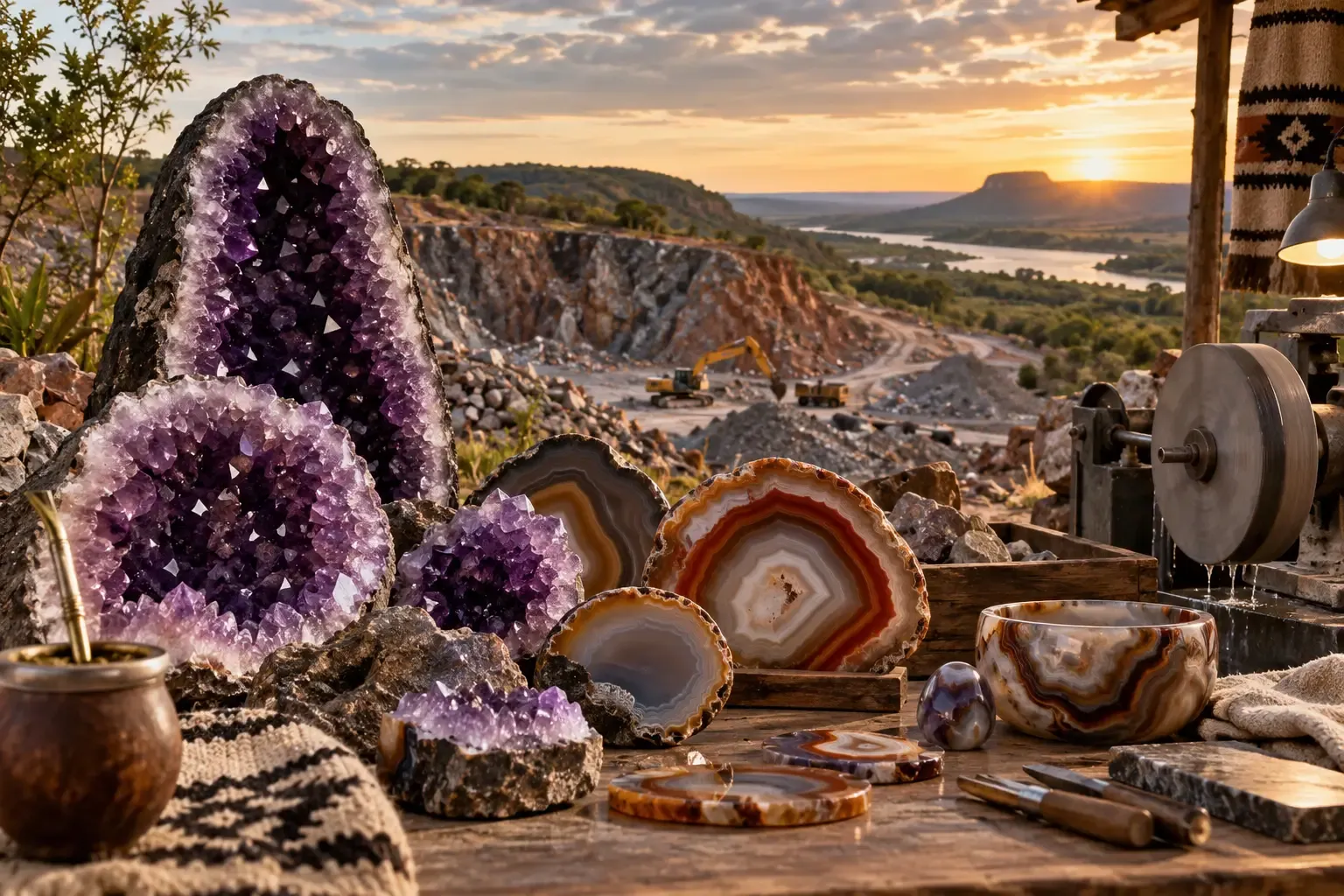
At the northern tip of Uruguay there is a region whose name is deeply linked to the violet of amethyst and the natural patterns of agate.
The gemstones of Artigas are one of the country’s most singular natural heritages and have carried the department’s name to markets, collections and exhibitions in different parts of the world.
But the importance of the agates and amethysts of Artigas goes far beyond their beauty.
Behind every piece there is a story that combines geology, mining, artisanal work, knowledge passed down through generations and a local identity closely tied to the stone.
Artigas, National Capital of Precious and Semi-Precious Stones
Artigas’s relationship with these minerals is so important that the department was officially declared the National Capital of Precious and Semi-Precious Stones, Agates and Amethysts.
The recognition reflects a reality that has long been visible in northern Uruguay: the region concentrates deposits of great relevance and a productive activity developed around them.
For many local families and businesses, the stones are part of everyday work.
For Uruguay, they are also an internationally known product.
What stones are found in Artigas?
The two inseparable names of the region are agate and amethyst.
Both have a composition based on silica, but their appearance is very different.
Amethyst
It is the violet variety of quartz.
It frequently occurs forming crystals inside geodes and can exhibit tones ranging from relatively light violets to very intense colors.
Agate
It is a material with a microcrystalline structure that is usually characterized by its bands.
When cut, lines, transparencies and patterns appear that turn every section into a different piece.
These two stones represent two completely different ways of appreciating the mineral wealth of Artigas.
Why is there agate and amethyst in Artigas?
The explanation begins with the geological history of the region.
Millions of years ago, enormous volcanic events generated the basaltic formations that today form part of the subsoil of northern Uruguay and neighboring regions.
During the cooling of those materials, cavities were left behind.
Later, mineral solutions capable of depositing silica circulated within certain spaces.
Over extensive periods, agate layers and, under the right conditions, quartz and amethyst crystals developed.
The rock extracted today is therefore the final product of a story spanning millions of years.
The Catalán mining region
One of the areas most closely associated with Uruguayan agates and amethysts is the Catalán region, in the department of Artigas.
Its deposits form a fundamental part of the history of the country’s semi-precious stone mining.
The presence of these mineralizations generated activities around them: extraction, transport, classification, cutting, polishing, commercialization and craftsmanship.
Thus, the stone ceased to be merely a resource present underground and became part of an entire productive chain.
From the quarry to a finished piece
The journey of an amethyst or an agate does not end when it comes out of the rock.
First, the material must be found and extracted.
Then selection begins.
Not all pieces have the same characteristics or are suitable for the same use.
A spectacular geode can be kept as a decorative piece, while other materials can be destined for cutting, lapidary work or the manufacture of objects.
Selection
Dimensions, color, quality and particular characteristics are analyzed.
Cutting
On certain pieces, a cut is made to reveal the interior or to prepare the material for later stages.
Polishing
Agates and other materials can be polished to highlight their bands and colors.
Lapidary work
Material suitable for jewelry can be transformed into gems with specific shapes.
Craftsmanship
Specialized workshops use the stones to develop decorative objects, souvenirs and unique pieces.
Each stage adds knowledge and work to the extracted material.
What makes Artigas amethyst special?
Amethyst from Artigas gained prestige especially for the quality that certain specimens can present.
The intensity of the violet is one of the most prized qualities.
Geodes of remarkable size, druses and formations with highly attractive crystals can also be found.
However, it is important to avoid absolute generalizations.
As with any natural deposit, quality and characteristics vary between pieces.
That diversity is precisely part of the value of natural minerals.
Agate: the other protagonist
It sometimes stands in the shadow of the spectacularity of amethysts, but agate deserves attention in its own right.
From the outside, a piece can look discreet.
When cut, a universe of bands emerges.
Some present extremely fine lines; others, large translucent zones or marked shifts in tone.
The artisan must decide how to cut and use that material to show the pattern created by nature in the best possible way.
Stones of Artigas around the world
The region’s production has historically been linked to foreign trade.
Uruguayan agates and amethysts have reached different international markets, where they may end up as collection minerals, ornamental objects, jewelry material or raw material.
In this way, a geological formation born beneath the soil of Artigas can end up exhibited thousands of kilometers from Uruguay.
An opportunity to see Uruguay from another perspective
When people abroad think of Uruguay, the first associations are usually Montevideo, the beaches, Punta del Este, football, mate or the countryside.
However, the country also has a geological heritage worth knowing.
Artigas offers a completely different perspective.
Its stones connect nature, science, industry, craftsmanship and local culture.
For anyone who enjoys mineralogy or is simply curious to discover lesser-known aspects of Uruguay, agates and amethysts are an extraordinary gateway.
Precious or semi-precious stones?
In everyday language it is common to speak of precious and semi-precious stones.
The traditional classification reserved the term “precious” for a very small group of gems and placed many others within the “semi-precious” category.
Today, from a gemological perspective, this division is too simple to describe the real value of a gemstone.
An exceptional piece of a mineral traditionally called semi-precious can be much rarer, more attractive or more valuable than another belonging to a different historical category.
That is why it is better to understand each material by its own characteristics.
Much more than a stone
An amethyst from Artigas can be beautiful even to a person who knows nothing of its history.
But when you understand where it comes from, the piece takes on another dimension.
It was created by geological processes of enormous antiquity.
It remained hidden underground.
It was discovered and extracted.
Someone evaluated its potential.
Perhaps it was cut, polished or worked by hands from Artigas.
And finally it reached whoever can observe it today.
The agates and amethysts of Artigas are, in that sense, an unrepeatable combination of nature and human work.
They are part of Uruguay’s heritage and one of the most extraordinary ways in which the country’s geology can tell its own story.
Frequently asked questions about the stones of Artigas
Why is Artigas known for its stones?
Because the department has important agate and amethyst deposits and a long history of extracting and transforming these minerals.
What is the most famous stone of Artigas?
Amethyst is probably the most internationally known thanks to its violet crystals, although agate is also fundamental to the region.
Are the amethysts of Artigas natural?
Those extracted from its deposits are natural mineral formations. When buying a specific piece, it is always advisable to ask about its provenance and possible treatments.
Where is Artigas?
The department is located in northern Uruguay, on the border with Brazil.
Do agates and amethysts form together?
They can appear associated within the same geological context, and certain geodes show different mineral layers before reaching the crystallized zone.