

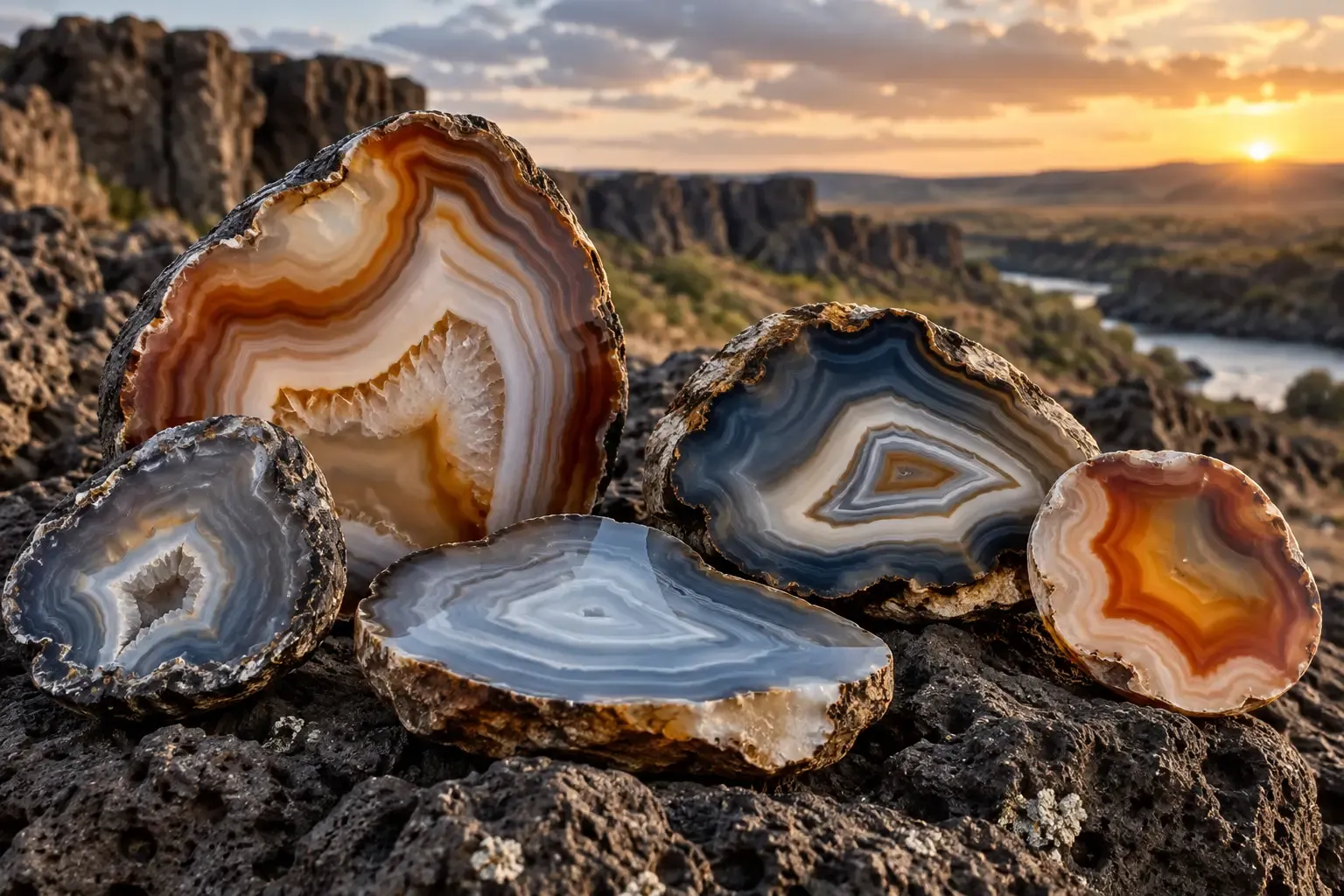
Uruguay agates are another of the great mineral treasures of the department of Artigas. Although amethysts often receive more attention for their spectacular violet crystals, agates possess a completely different beauty: bands, transparencies, patterns and natural combinations that turn every cut into a unique composition.
Observing a good piece of agate is like looking at a miniature landscape. Curved lines, concentric layers and shifts in tone visually tell part of the story of its formation.
What is agate?
Agate is a microcrystalline variety of silica, usually related to chalcedony.
Unlike a large quartz crystal, in which we can easily distinguish faces and points, the crystalline structure of agate is extremely fine.
One of its most recognizable visual characteristics is the formation of successive bands or layers.
These bands can present different colors, degrees of transparency, thicknesses and shapes.
For this reason, when a piece of agate is cut and polished, designs appear that could not be fully observed from the outside.
Where is there agate in Uruguay?
The department of Artigas is home to important agate and amethyst mineralizations.
The Arroyo Catalán region and other areas of the so-called basaltic zone are closely linked to this geological wealth.
Agate and amethyst are not isolated elements in this story. They often form part of the same geological context and can be found associated with structures formed within ancient volcanic rocks.
How does agate form?
Its formation is a process that requires time and very particular geological conditions.
Millions of years ago, volcanic activity produced enormous quantities of lava in the region. During its cooling, cavities were left in the rocks.
Later, silica-rich fluids penetrated some of those cavities.
The material was progressively deposited on the walls.
Instead of instantly filling the space, different stages of deposition formed layers.
Those layers are responsible for many of the patterns we observe today in a section of agate.
Each change in conditions can produce variations in color, transparency or structure.
That is why its pattern works almost like a record of the geological process that occurred inside the stone.
Why do agates have lines?
The famous lines of agate are the result of that progressive deposition of minerals.
In many pieces they roughly follow the shape of the cavity where they grew.
When the material is cut transversally, concentric bands, curves and shapes appear that can resemble waves, eyes, clouds or landscapes.
They are not designs made by a person.
They are structures created naturally over enormous periods of time.
What color can agate be?
The answer is very broad.
In their natural state, combinations can be found of:
- whites;
- grays;
- bluish tones;
- browns;
- reddish tones;
- yellowish tones;
- blacks;
- translucent tones.
In addition, different layers of the same piece can present different colors.
It is important to keep in mind that artificially colored agates also exist on the market.
Therefore, if the interest is specifically in a piece with natural color, it is advisable to know its origin and treatment.
Natural agate and dyed agate
Agates are porous materials at a microscopic scale, and certain varieties can accept treatments that modify their appearance.
Dyeing has been widely used to create intense colors.
This does not necessarily mean that a dyed piece lacks decorative value, but it is important to clearly distinguish an agate of natural color from one that has been treated.
A responsible business should indicate the treatment when applicable.
What is made with agate?
Its hardness, ability to take a polish and beauty give it numerous applications.
It can be used to make:
Decorative objects
Polished sections, bases, small objects, lamps and ornamental pieces.
Handicrafts
Artigas has a long tradition of work related to local stones.
Jewelry
Sections with attractive patterns can be cut and polished for pendants, rings, earrings and other pieces.
Mineral collections
Collectors may seek specimens both for their beauty and for their geological origin.
Design elements
The contrast between natural bands makes certain cuts work very well in interior design and exclusive pieces.
How is a piece of agate cut?
Before cutting, an externally discreet piece can hide a spectacular pattern.
To reveal its interior, tools capable of cutting materials of high hardness are used.
Once the section is obtained, polishing smooths the surface and better highlights its natural patterns.
The orientation of the cut is very important.
Depending on where and how it is made, the same stone can show different patterns.
How can you tell if an agate is authentic?
There is no single visual characteristic that allows any piece to be diagnosed at a glance.
However, natural agates usually present variations, bands, translucent zones and irregularities consistent with a geological material.
Extremely uniform or artificially intense colors may raise suspicion of treatments, although they are not by themselves definitive proof.
If the piece has special value, provenance and the advice of a specialized seller are important elements.
The beauty is on the inside
One of the particularities of agate is that its exterior may not anticipate what will appear after cutting.
That moment when the rock reveals its inner layers explains much of the fascination it awakens.
Each line represents a different stage of a natural process that occurred millions of years ago.
That is why it is practically impossible to find two exactly identical sections.
Agates and amethysts: two sides of the mineral wealth of Artigas
Although they are visually very different, both form part of the same geological heritage.
Amethyst stands out for its violet crystals.
Agate does so through patterns and bands.
Together they have helped make Artigas a reference point for those interested in minerals, geology, craftsmanship and ornamental stones.
Frequently asked questions about Uruguay agates
In which department of Uruguay is agate found?
Artigas is the Uruguayan department most closely associated with the extraction of agates and amethysts.
Are the lines in agate natural?
Yes. Its bands form during successive stages of mineral material deposition.
Do all agates have the same colors?
No. The tones and patterns can vary widely.
Are there dyed agates?
Yes. Dyeing is a known treatment, so it is worth asking whether a piece retains its natural coloration.
Why is agate polished?
Polishing creates a smooth surface and allows the stone’s inner design to be appreciated much more clearly.